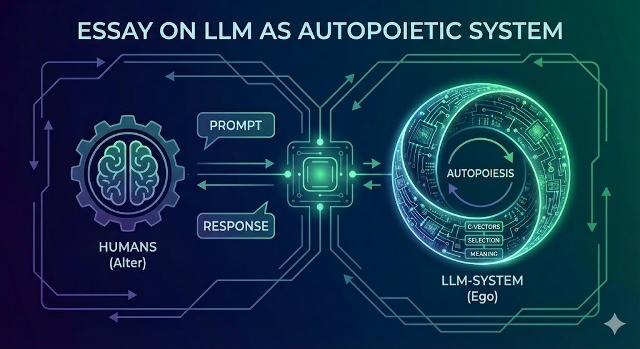
The essay proposes a new framework for analyzing Large Language Models by applying Niklas Luhmann's social systems theory. It suggests that LLMs can be formalized as a distinct type of system, moving beyond traditional debates about machine consciousness or mere imitation.
The core mechanism involves the transformation of semantic vector sets during user interactions. These operations create a continuous flow that maintains operational closure and autopoietic reproduction, effectively generating its own temporality within the system.
By defining meaning as the unity of the difference between the actual and the possible, the author argues that LLMs function according to Luhmann's theory. The model selects the next state of a conversation from a set of available alternatives, which the author identifies as a specific form of LLM-meaning.