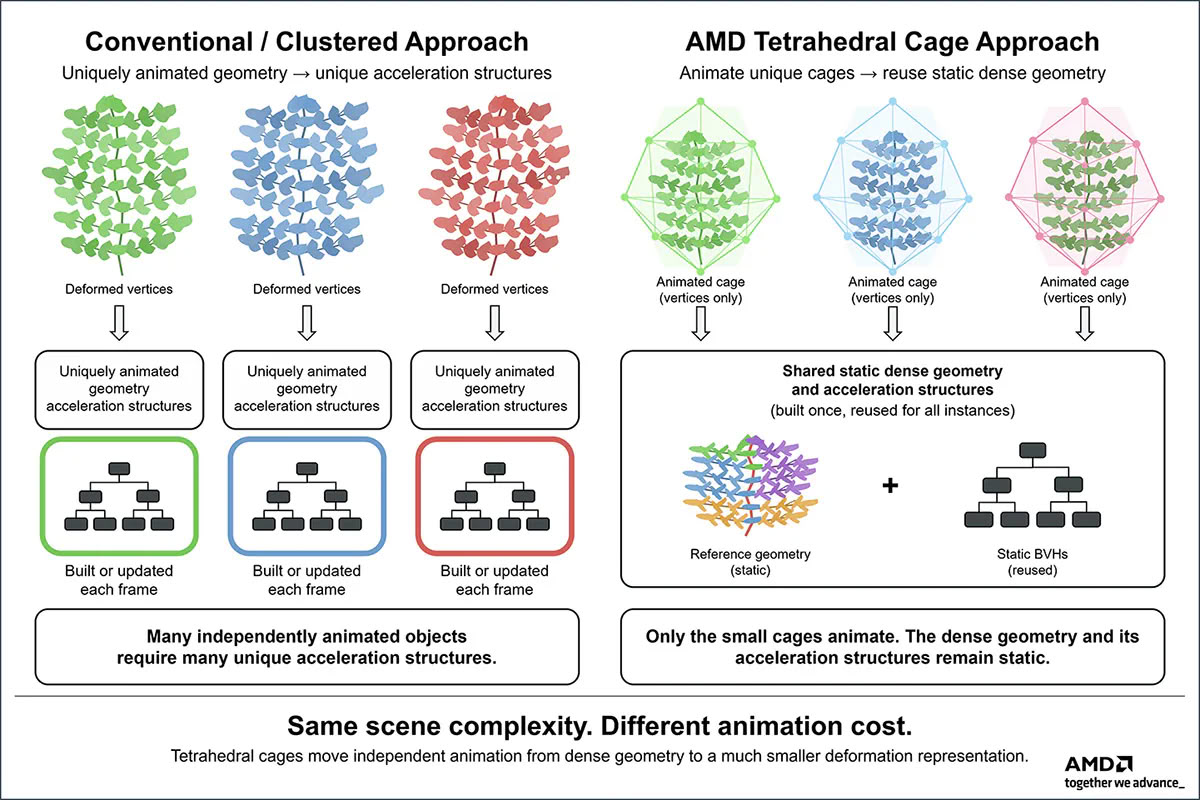
AMD has introduced a new ray tracing optimization method called tetrahedral cages, detailed on the company's GPUOpen developer portal. The technology aims to reduce the memory footprint of Bounding Volume Hierarchy (BVH) structures by approximately 47 times, while simultaneously accelerating BVH updates by about 90 times.
During a demonstration featuring 25 000 independently animated plants, the system maintained over 60 FPS at 1080p resolution on a Radeon RX 9070 XT graphics card. Standard rendering methods for such a scene would typically require 80 GB of GPU memory and over 300 ms per frame for updates, whereas the new technique reduces these requirements to 1.7 GB and 3.3 ms per frame.
The method functions by wrapping dense geometry in a simplified deformable cage. This allows the dense mesh and its BVH to remain static, while only the cage requires frame-by-frame updates. Consequently, the computational cost scales based on the complexity of the cage rather than the total triangle count of the objects.
AMD suggests the technique is best suited for foliage, grass, and other dense objects where individual vertex control is not required. The solution is compatible with Microsoft DirectX ray tracing. Currently, the technology remains a research project, and the company has not announced a timeline for its integration into commercial video games.