

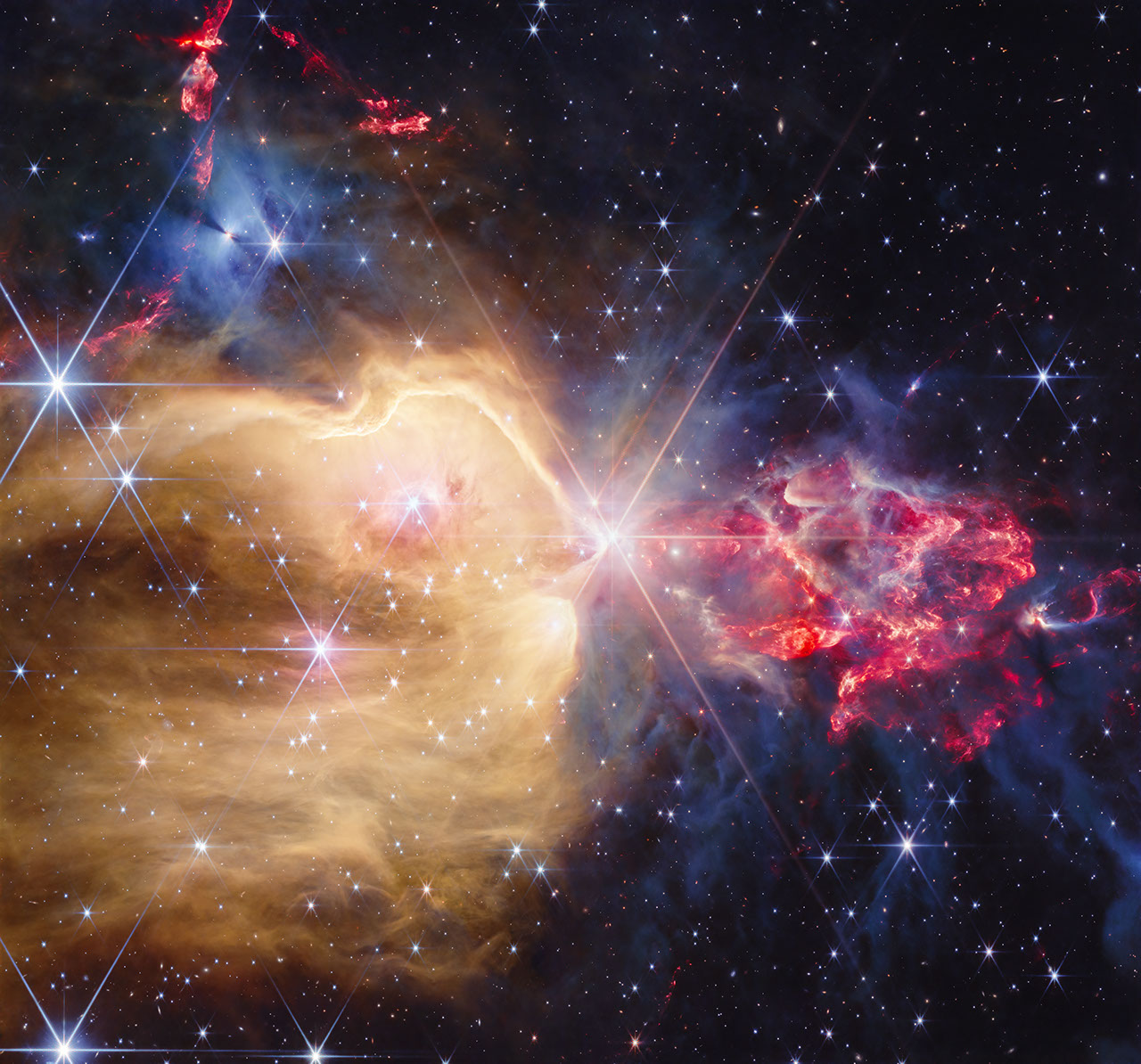
The James Webb Space Telescope has captured new imagery of the NGC 7129 stellar nursery, located approximately 3,300 light-years from Earth. The telescope utilized its infrared sensitivity to observe protostars and stars previously obscured by dense clouds of gas and dust.
The central star of the region, LkH-alpha 234, is a pre-main-sequence star with a mass estimated at 5 to 8 times that of the Sun. Observations reveal a golden cavity spanning about 3.5 light-years, formed by stellar outflows that interact with surrounding molecular hydrogen.
The data highlights various stages of stellar development, including younger protostars that eject superheated material. These interactions create distinct structures, such as bow shocks and a photodissociation region where molecular hydrogen breaks down into atoms.
Compared to previous observations by the retired Spitzer Space Telescope, the Webb imagery provides higher spatial resolution. This allows for a more detailed analysis of gas filaments and the identification of background galaxies within the region.



