

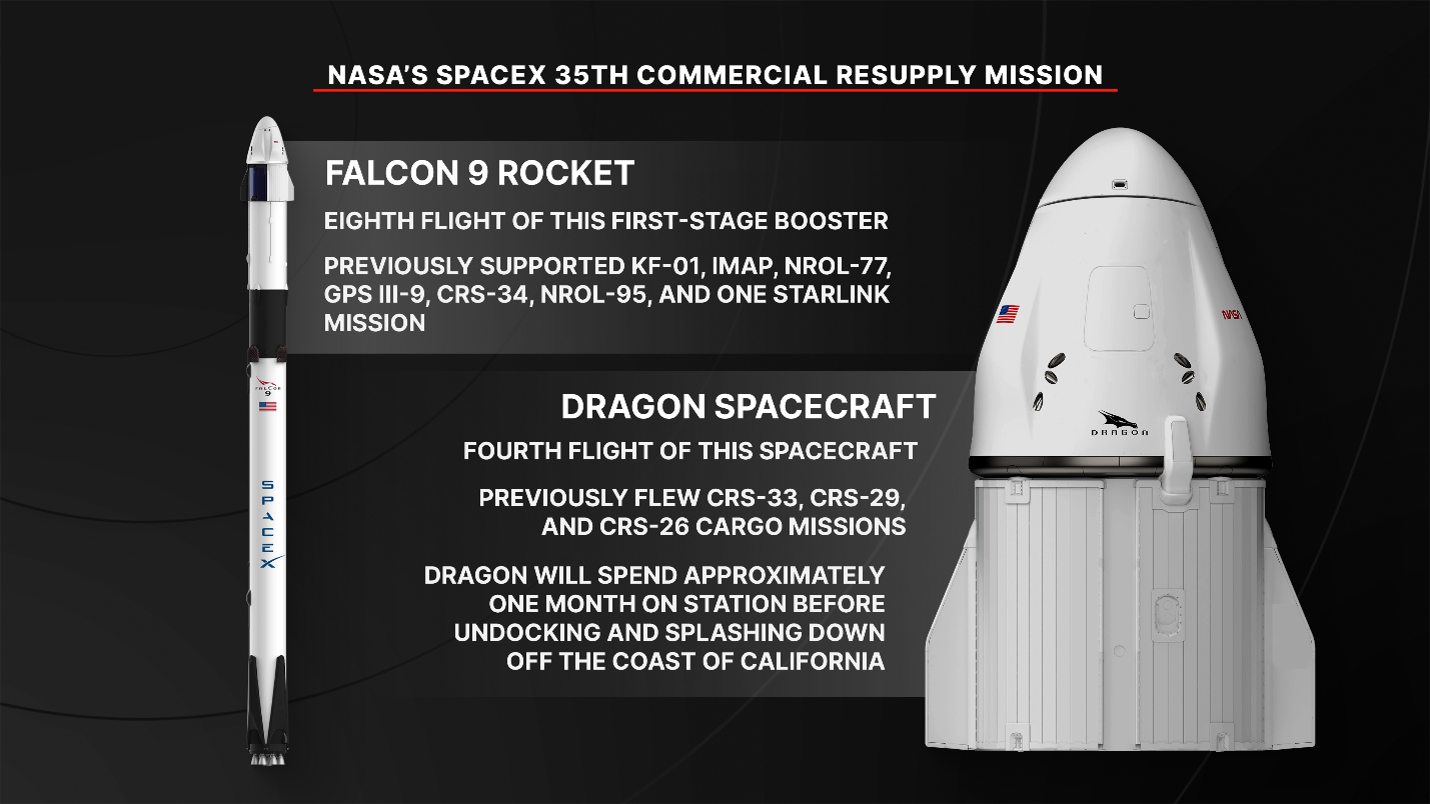
NASA and SpaceX are preparing for the 35th commercial resupply mission to the International Space Station, scheduled for launch no earlier than Tuesday, Oct. 13. The SpaceX Dragon spacecraft will carry over 6,300 pounds of cargo, launching on a Falcon 9 rocket from Space Launch Complex 40 at Cape Canaveral Space Force Station in Florida.
The mission includes several scientific experiments, such as LambdaVision-1 for manufacturing artificial eye retinas, the Stellar Spheroids study on 3D human heart tissue, and ELF-Unconventional Glass 2 for testing glass formation in microgravity. Additionally, the MINDS experiment will analyze brain organoids to study inflammation related to neurodegenerative diseases.
The cargo manifest features critical hardware, including the final pair of International Space Station Roll-Out Solar Arrays (IROSA) to complete the station's power system upgrade. The flight also carries a test unit for the Artemis III mission, a toilet dose pump, and maintenance tools for the station's external units.
Upon arrival, the Dragon spacecraft will autonomously dock to the Harmony module. Astronauts Anil Menon and Jessica Watkins will oversee the docking process. The spacecraft is expected to remain at the orbital complex for approximately one month before returning to Earth in mid-November.
The return cargo will include a failed Canadarm2 robotic arm joint, which was replaced during a spacewalk on June 30, for ground analysis. Other returning items include a spacesuit for refurbishment, a fluid- and pressure-control pump assembly, and a water processor filtration unit.



