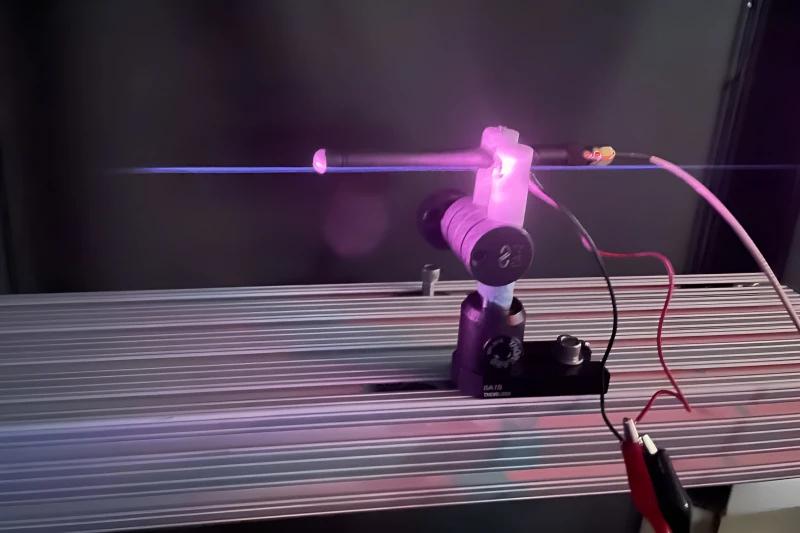
Researchers at North Carolina State University have successfully demonstrated a plasma-based antenna generated by a laser. The system utilizes a thin filament of ionized air to transmit radio signals, functioning as a conductive channel for electromagnetic waves. Unlike traditional metal antennas, this setup uses a laser to ionize gas molecules, creating a path of free electrons and positive ions that acts as a signal radiator.
To avoid structural interference, the team implemented a non-contact signal delivery method. A metal ring acting as a capacitor surrounds the laser path, inducing an alternating electric field that interacts with the plasma filament. This allows the plasma to emit radio waves without physical contact, preserving the integrity of the ionized channel during operation.
In laboratory tests conducted at a frequency of 30 MHz, the plasma antenna demonstrated a significant performance increase. With the laser active, the received signal level was 2.5 times higher compared to tests without the plasma filament, representing a 150% improvement. The measurements were performed in the near field at a distance of 5 cm from the filament.
The technology offers potential advantages for satellite communications and radar systems, where physical antenna deployment is complex. By adjusting laser parameters, researchers can modify the length and direction of the plasma filament without mechanical movement. Future work will focus on energy requirements for maintaining the plasma and evaluating signal transmission efficiency in various conditions.