

The model is released under the Apache 2.0 license and is compatible with vLLM, SGLang, Transformers, llama.cpp, Ollama, LM Studio, MLX, and FlagOS. It is designed specifically for on-device deployment, focusing on agentic and tool-calling workloads rather than general knowledge.
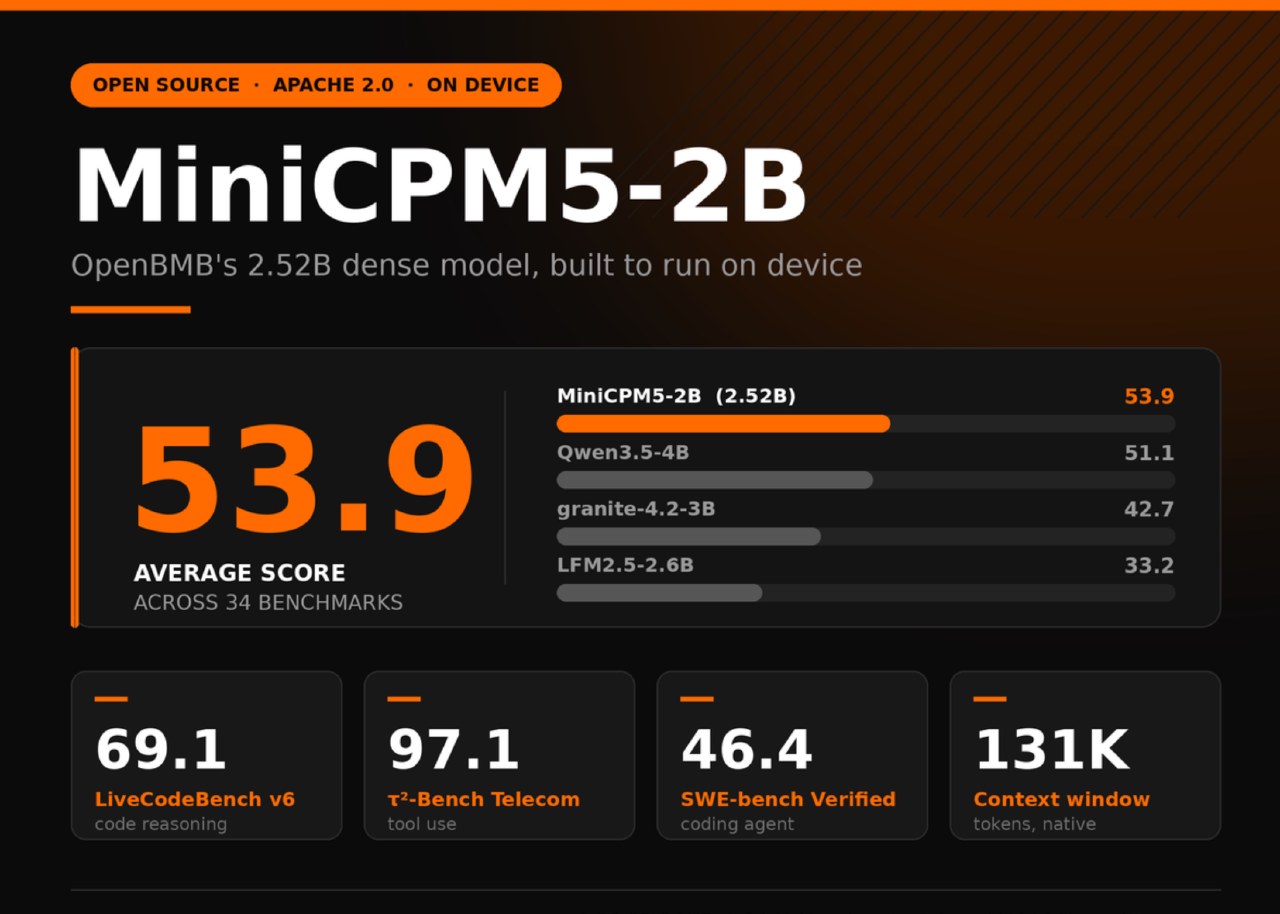
In performance tests across 34 benchmarks, MiniCPM5-2B achieved an average score of 53.9. This outperforms competitors in its size class, including Qwen3.5-4B (51.1), granite-4.2-3B (42.7), and LFM2.5-2.6B (33.2).
The model shows significant strength in tool use and coding. It scored 97.1 on τ²-Bench Telecom, 66.6 on BFCL v4, and 20.8 on τ³-Bench Banking. In code reasoning, it reached 69.1 on LiveCodeBench v6 and 46.4 on SWE-bench Verified.
Training utilized the UltraData tiered management method, involving stable and decay phases, followed by mid-training. Post-training included 400B tokens of deep-thinking SFT and the JustRL II algorithm to train specialized RL teachers for math, code, writing, and agentic tasks.
The final stage involved on-policy distillation (OPD), merging 16 RL experts, including five agentic ones, into a single model. OpenBMB reports that the RL and OPD stages added 10.96 average points to reasoning and general benchmarks and 6.96 points to agentic tasks.
OpenBMB also released several datasets, including Ultra-FineWeb, UltraX, and UltraData-Code. Specifically, UltraData-SFT-Agent-2609 contains 500K agent samples, while UltraData-RL-2609 includes over 80K RL samples. Intermediate checkpoints for Base, Midtrain, and SFT-only stages are also available.



