

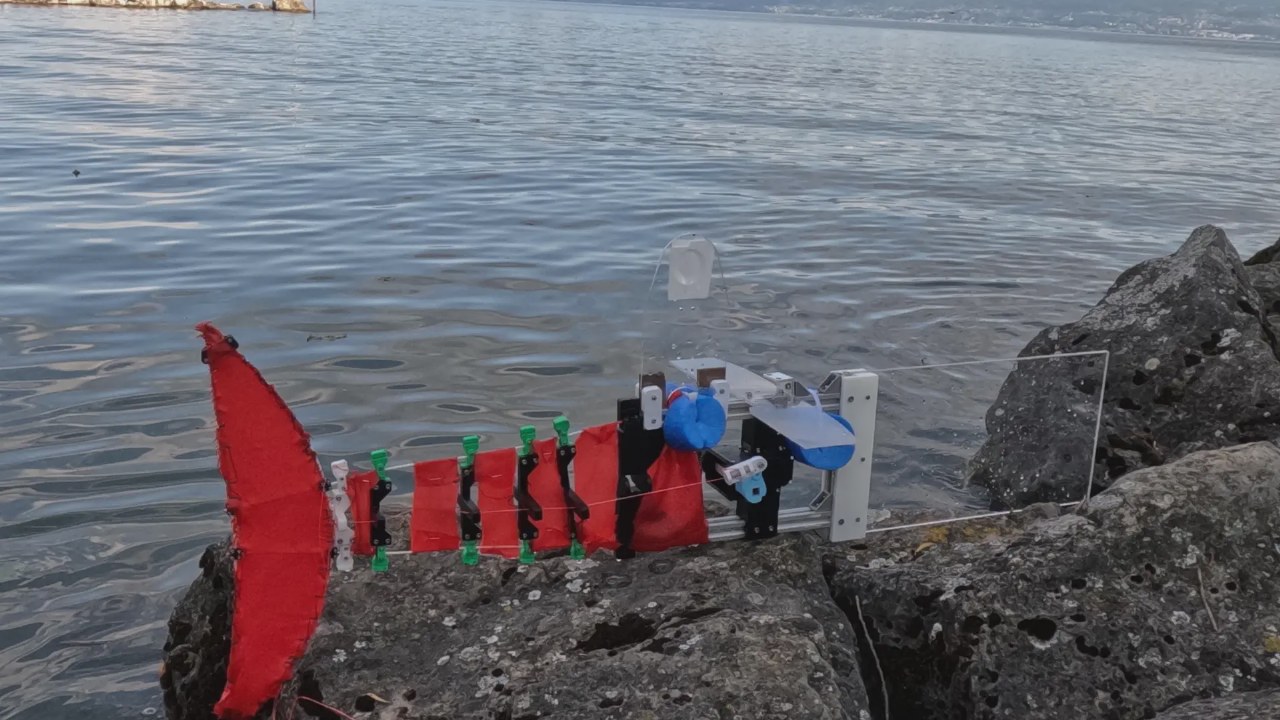
The robot's structure consists of two main parts: a front section housing the motors and electronic components, and a rear section featuring a flexible tail made of fiberglass rods and fabric. A single motor operates two crossing cables near the tail's end to create an S-shaped bend, enabling silent forward movement through side-to-side swinging.
The propulsion mechanism is designed for scalability. Researchers noted that the front motor and cable system remain constant regardless of the size of the robot, meaning only the diameter of the tail rods needs adjustment to scale the device up or down.
To test the concept, the team built three versions of ScaFi with lengths of 0.6 meters, 1.1 meters, and 2.9 meters. These were deployed in various environments: the smallest version in streams 15 to 30 centimeters deep, the medium version in a Swiss stream, and the largest version in Lake Geneva.
Testing revealed that the smaller version is more flexible and mimics real fish more closely. While the larger version showed decreased maneuverability and lower energy efficiency, it demonstrated better stability in water currents. All three robots continued to swim even after GPS signal loss.