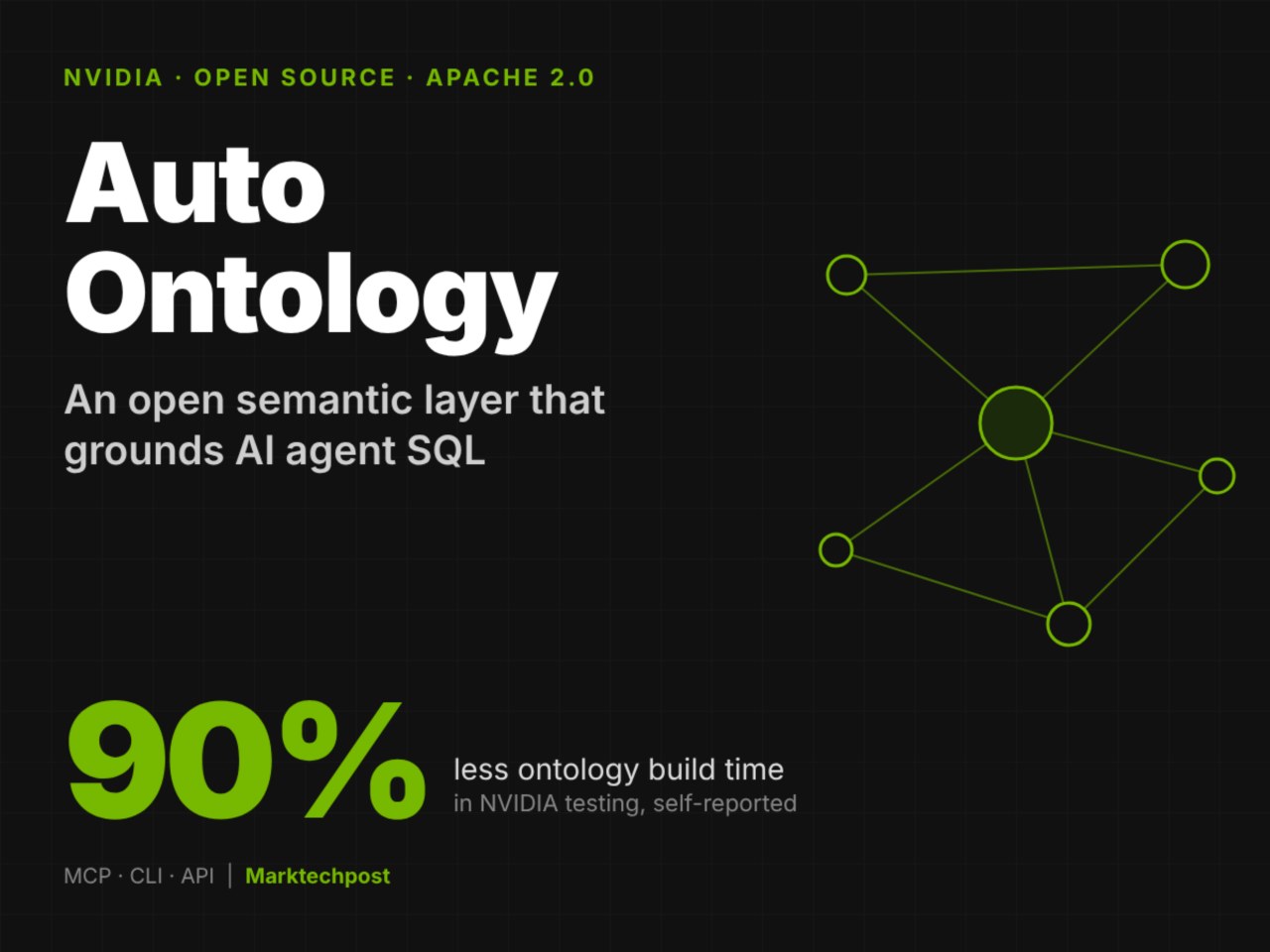
NVIDIA has launched Auto Ontology, an open-source semantic layer designed to bridge the gap between AI agents and data warehouses. The system acts as a context layer, providing agents with information on data location, field definitions, and usage instructions. Business experts are responsible for testing and certifying the initial ontology.
The architecture consists of four core services: a Next.js 16 frontend, a FastAPI backend integrated with LangChain, an ingestion worker for embeddings, and a Postgres database with pgvector. The system supports source databases including Databricks, Snowflake, DuckDB, and Postgres, while allowing the use of any OpenAI-compatible model endpoint.
The platform includes nine read-only tools via an MCP server, with results capped at 100 rows per query. It enforces data access through the semantic layer rather than raw schema browsing, utilizing an OpenAPI specification with 87 operations. Security is managed via OAuth, ensuring all calls respect user permissions.
For evaluation, NVIDIA provides the auto-ontology-eval harness, which compares schema-only LLM control against ontology-grounded agents using NeMo Gym. The evaluation includes datasets such as BIRD Dev with 1,534 questions, Mini-Dev with 500 questions, FDABench-Lite with 169 questions, and a 100-question sample from BEAVER.
Deployment options include Docker Compose, Kubernetes via Helm charts, and an NGC container. Users can access default models through an NVIDIA API key. The system requires configuration via environment variables, with specific routing for reasoning, embedding, and reranking roles.