

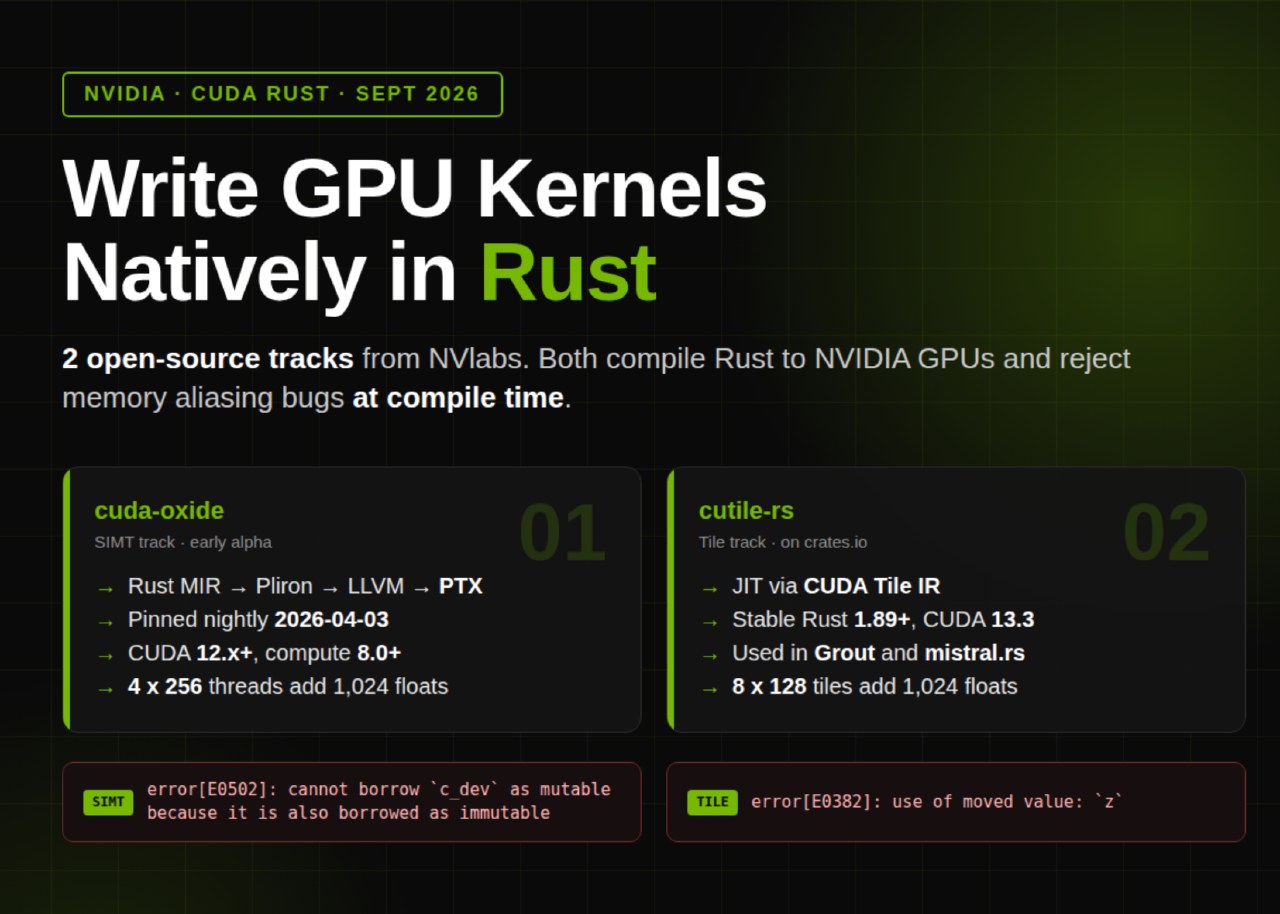
NVIDIA has introduced two new Rust-based projects, cuda-oxide and cutile-rs, designed to enable compile-time-safe GPU kernel development. Both tools are currently in the alpha phase and are not yet recommended for production environments.
The cuda-oxide project provides a custom rustc codegen backend that routes kernel functions through Rust MIR, Pliron IR, and LLVM IR to PTX. It requires Linux, a GPU with compute capability 8.0 or higher, CUDA 12.x, and a specific nightly toolchain from April 3, 2026.
The cutile-rs library operates at a higher abstraction level, using a tile-based programming model where the compiler manages thread mapping. It is compatible with stable Rust 1.89 or newer and requires CUDA 13.3. This tool is already integrated into the Grout inference engine and mistral.rs.
These projects align with NVIDIA's broader strategy to incorporate Rust into its software stack, including the Nova Linux driver and Dynamo. The company plans to ensure inter-language interoperability, allowing developers to combine Rust code with existing C++ and Python implementations.



