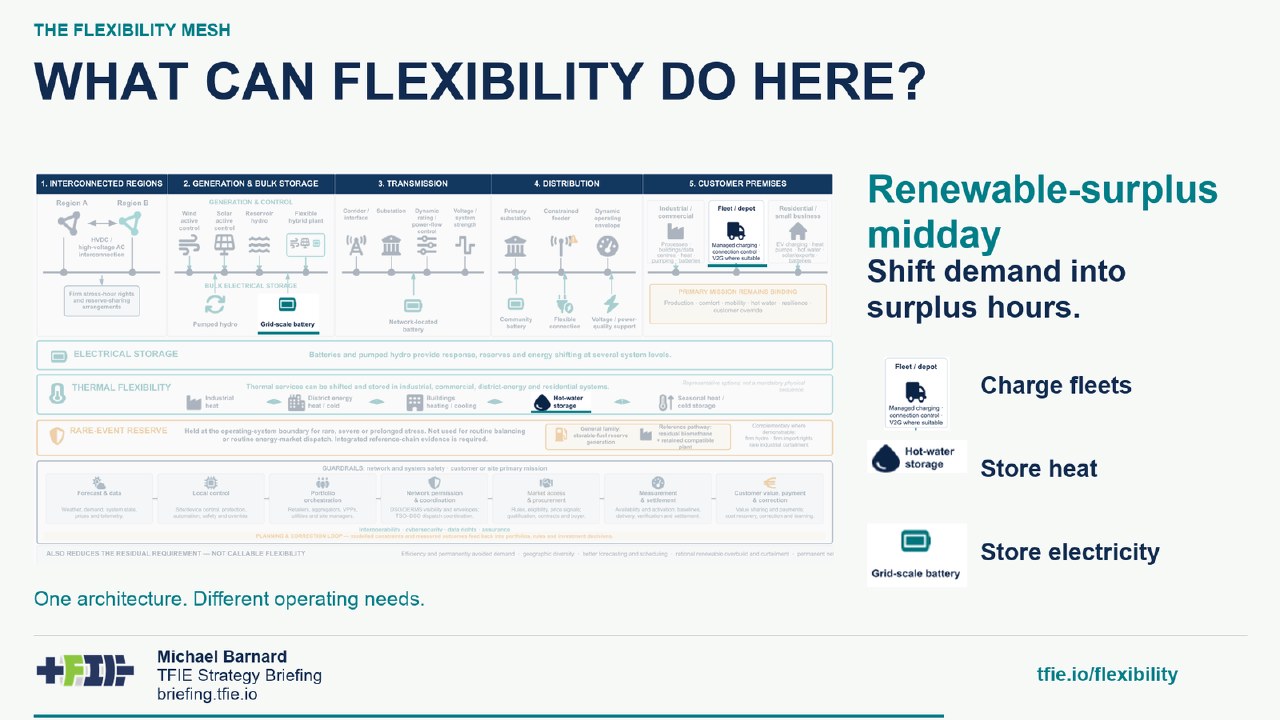
Michael Barnard has released a 99-page report titled The Flexibility Mesh: A Whole-System Architecture for Reliable, Affordable Electrification. The document proposes a framework for managing electricity grid flexibility by categorizing it as a system property rather than a collection of specific technologies.
The report highlights that grid flexibility resources, such as batteries, electric vehicle charging, and virtual power plants, must be electrically relevant to specific network constraints to be effective. It emphasizes that theoretical capacity does not guarantee dependable delivery, as administrative, regulatory, and commercial factors often limit actual performance.
The architecture addresses the economic challenges of grid management by separating system value, buyer budgets, provider revenue, and customer benefits. It argues that business models must reconcile these distinct financial quantities rather than assuming they are interchangeable.
The study includes an interactive version that allows users to explore how different operating moments, such as renewable-surplus periods or winter peaks, require specific resources and coordination. It aims to help grid operators identify which services are needed and how to verify their delivery.