

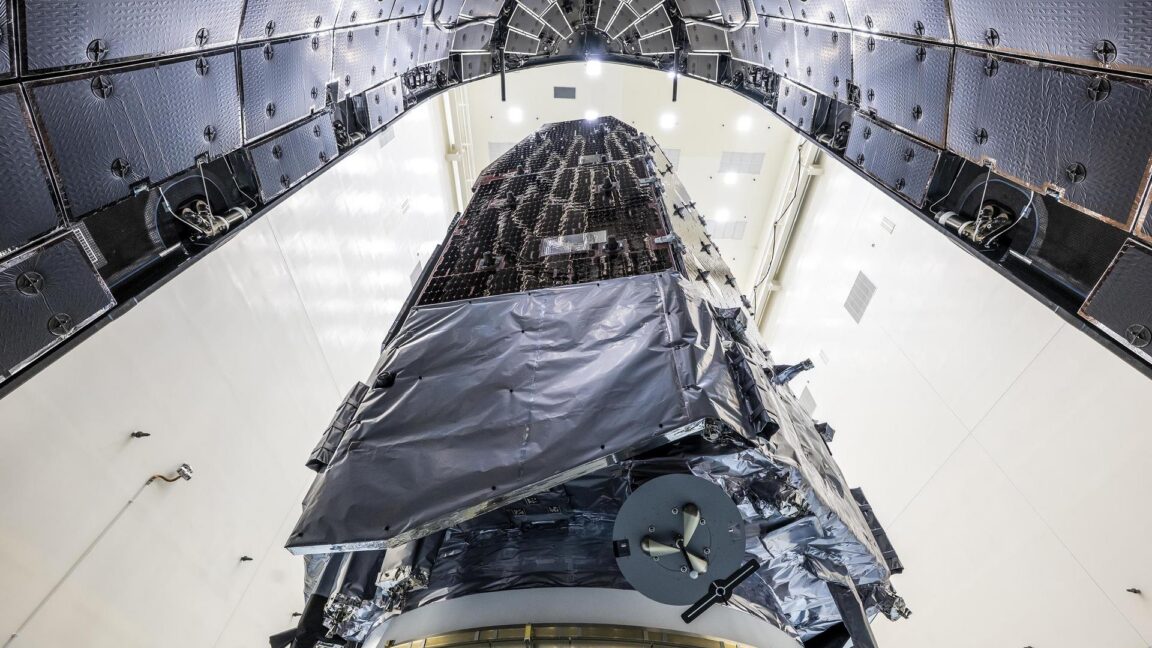
The $4.3 billion Roman Space Telescope has enough fuel for at least 22 years of operations, significantly exceeding the initial 5-to-10-year design estimate. The observatory launched on August 30 aboard a SpaceX Falcon Heavy rocket from Kennedy Space Center, reaching orbit nine months ahead of the 2020 schedule.
The mission's extended lifespan is attributed to a precise launch and the spacecraft's lower-than-expected mass. At completion, the telescope weighed 8,056 kilograms, about two tons under its limit. This allowed ground crews to load 290 gallons of hydrazine, while the first course correction maneuver consumed only 18 kilograms of fuel instead of the allocated 200 kilograms.
Roman is currently traveling toward the Sun-Earth L2 Lagrange point, a journey expected to take three months. Once in position, the telescope will use its Wide Field Instrument, featuring 18 near-infrared detectors and 300-megapixel imaging capability, to map galactic clusters and study dark energy.
Although the observatory is designed to be refuelable, NASA currently has no servicing spacecraft capable of reaching the L2 point, located one million miles from Earth. The telescope is equipped with a grapple fixture and navigation aids to facilitate potential future robotic docking and refueling missions.
Preliminary post-launch checks confirm that all systems are functioning correctly. The aperture cover opened on September 1, and initial data from the Wide Field Instrument and the exoplanet coronagraph indicate that all 18 detectors are operating as expected.



