

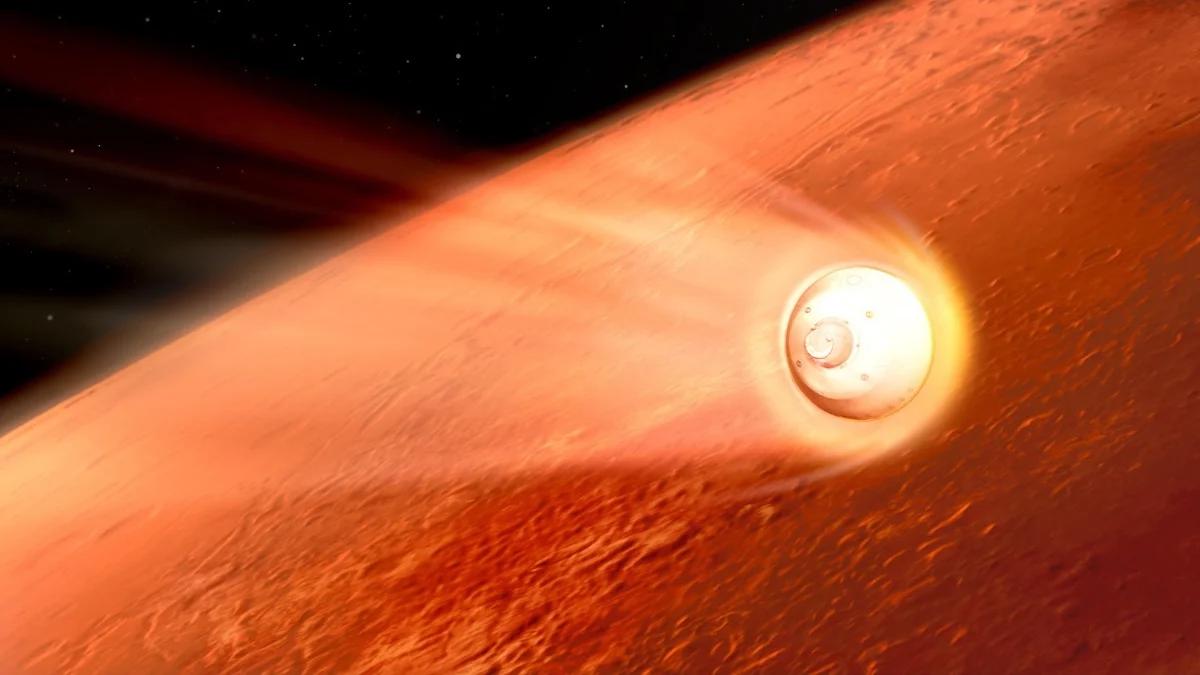
During the Mars 2020 mission entry, the spacecraft released two tungsten ballast weights, each weighing 77 kilograms, at an altitude of 1300 kilometers and a velocity of 4.7 kilometers per second. These weights, along with 540 kilograms of cruise stage debris, impacted the Martian surface at an angle of 10 degrees.
The impact created five craters located 70 kilometers northwest of the Jezero crater rim. NASA engineers used these impacts as a controlled experiment, as the mass, speed, and angle of the objects were precisely known. The craters were identified using images from the Mars Reconnaissance Orbiter.
Analysis of the site and 3D shock-wave modeling revealed a soil cohesive strength of 7 kilopascals, comparable to damp sand. This finding aligns with previous data from the InSight mission's thermal probe but contradicts standard crater scaling laws, which may be off by an order of magnitude for high-density impacts.



