

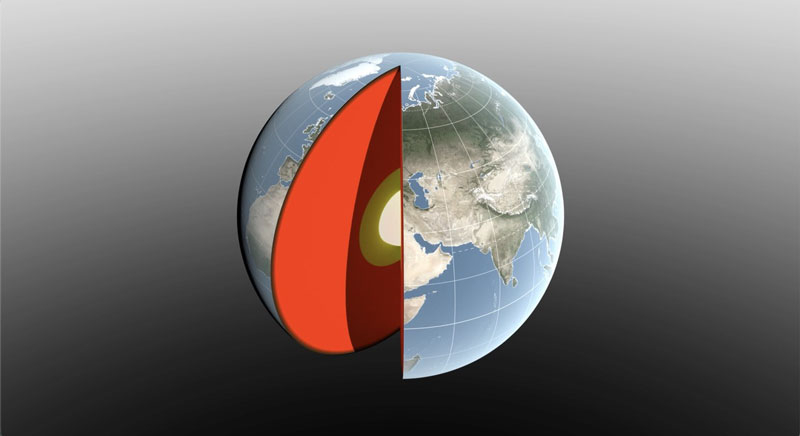
NASA researchers have developed a new method to track the seasonal shifts of Earth's center of mass, known as the geocenter, with millimeter-level precision. This center of mass does not align with the geometric center of the planet, as it fluctuates due to the movement of water, ice, and atmospheric masses.
The new technique, led by geophysicist Donald Argus at NASA JPL, combines GPS tracking with data from low-Earth orbit satellites. Unlike traditional laser ranging methods, this approach accounts for the deformation of the Earth's crust caused by seasonal changes in water and ice loads, which helps correct errors in ground station positioning.
Calculations indicate that annual fluctuations of the geocenter are about half of what was estimated eight years ago. For instance, snow accumulation in the Northern Hemisphere in March shifts the center of mass by approximately 3 mm toward the North Pole, while water mass in the Amazon basin in April causes a 2.2 mm shift.
These findings align with data from the GRACE-FO mission, which has been monitoring mass redistribution since 2018 by measuring gravitational changes between two satellites flying in formation. NASA intends to continue this long-term observation series with the upcoming GRACE-C mission, scheduled for launch in late 2028.



