

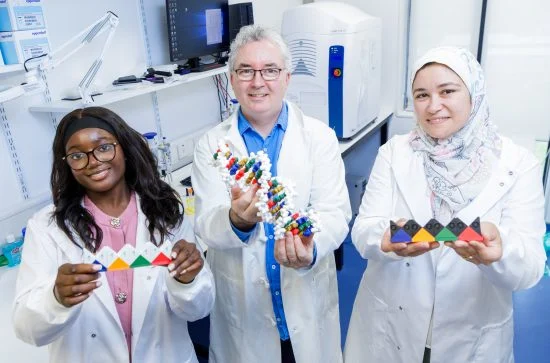
Researchers at Maynooth University have developed a DNA-based computer that performs calculations using chemical reactions in a salt solution. This system operates without the need for a continuous external power supply, marking a shift from traditional silicon-based architectures that rely on power-consuming transistors.
The process involves using a long nucleic acid scaffold combined with shorter DNA strands. As the solution cools, the molecules self-assemble into stable structures that represent the solution to a given problem. This approach allows the system to naturally evolve toward a low-energy state, eliminating the need for constant energy input during computation.
Experimental tests demonstrated the system's ability to run various programs, including calculations with a scale of up to 100 bits. While a simple addition of 3 and 10 takes approximately 30 seconds, the researchers noted that this is currently the fastest speed achieved among existing DNA computing systems.
The team highlights that DNA computing is not intended to replace CPUs in terms of raw speed. Instead, its value lies in high-density data storage and massive parallelism. DNA can theoretically store hundreds of millions of gigabytes per gram, making it suitable for long-term storage and processing of large datasets without converting them into electronic signals.

