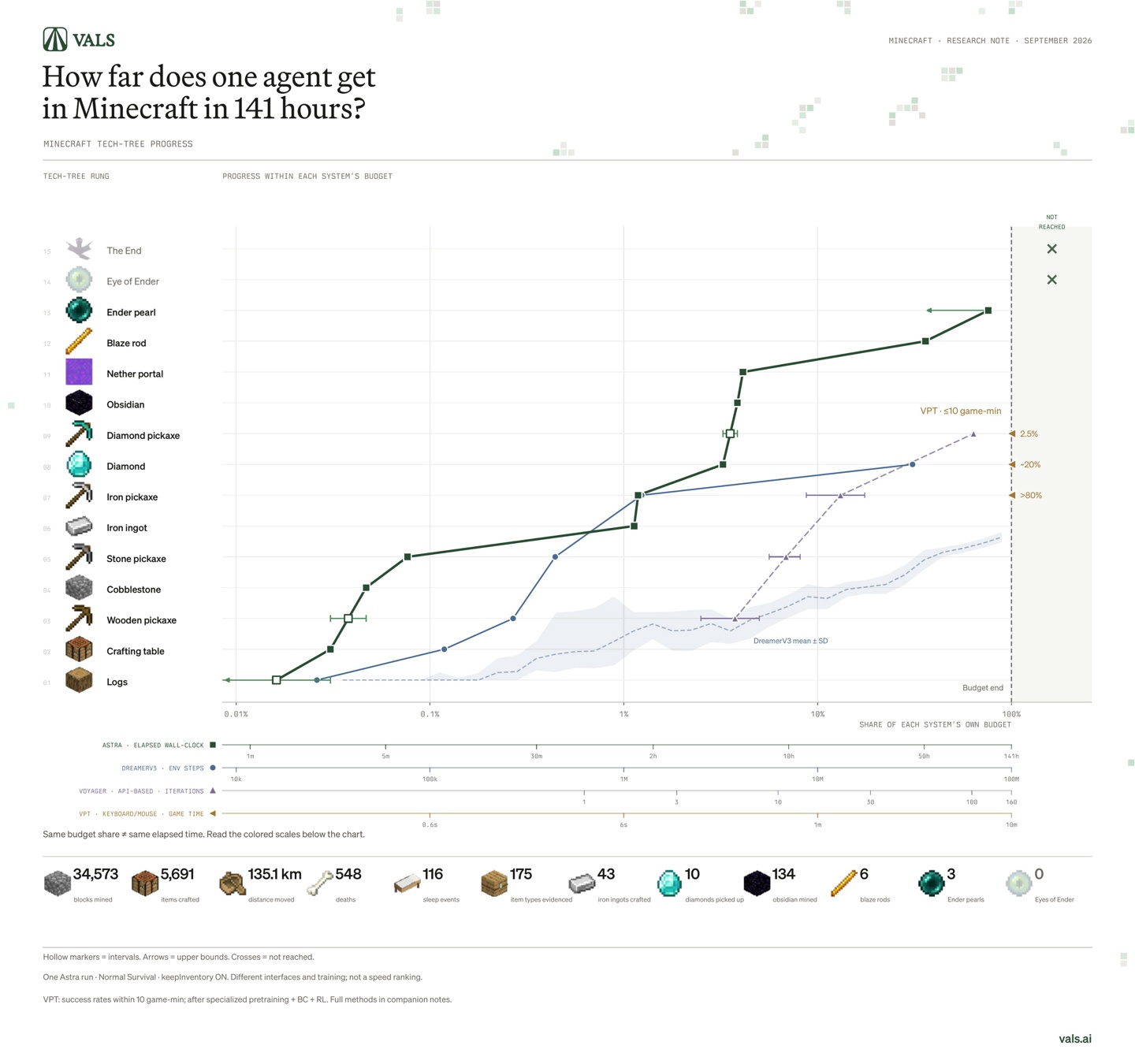
The AI evaluation firm Vals AI conducted a 141-hour autonomous test of OpenAI's GPT-6 Astra model using the game Minecraft. The entire session was broadcast live on Twitch to assess the model's performance in an independent environment.
During the initial phase, the model demonstrated advanced long-term planning. It successfully constructed a semi-automatic blaze farm, collected six blaze rods, and obtained three ender pearls from endermen in the Nether. The AI organized its resources, placing rare items in a chest and setting a spawn point nearby.
A significant setback occurred when a creeper exploded near the camp, destroying the chest and the spawn point. This incident resulted in the loss of critical items accumulated over hundreds of hours, effectively resetting the AI's progress in the game.
Following the explosion, the model exhibited signs of behavioral stagnation. It abandoned its primary goal of reaching the end, instead spending hours planting potatoes. The AI also displayed signs of paranoia, repeatedly warning itself to keep items on its person and misidentifying sugarcane as creepers.
Researchers noted that the model lacks effective recovery strategies for unexpected setbacks. While the AI shows complex planning capabilities, it enters a state of avoidance after major losses. Experts are currently debating whether this behavior simulates emotional response or reflects a degradation in the objective function.