

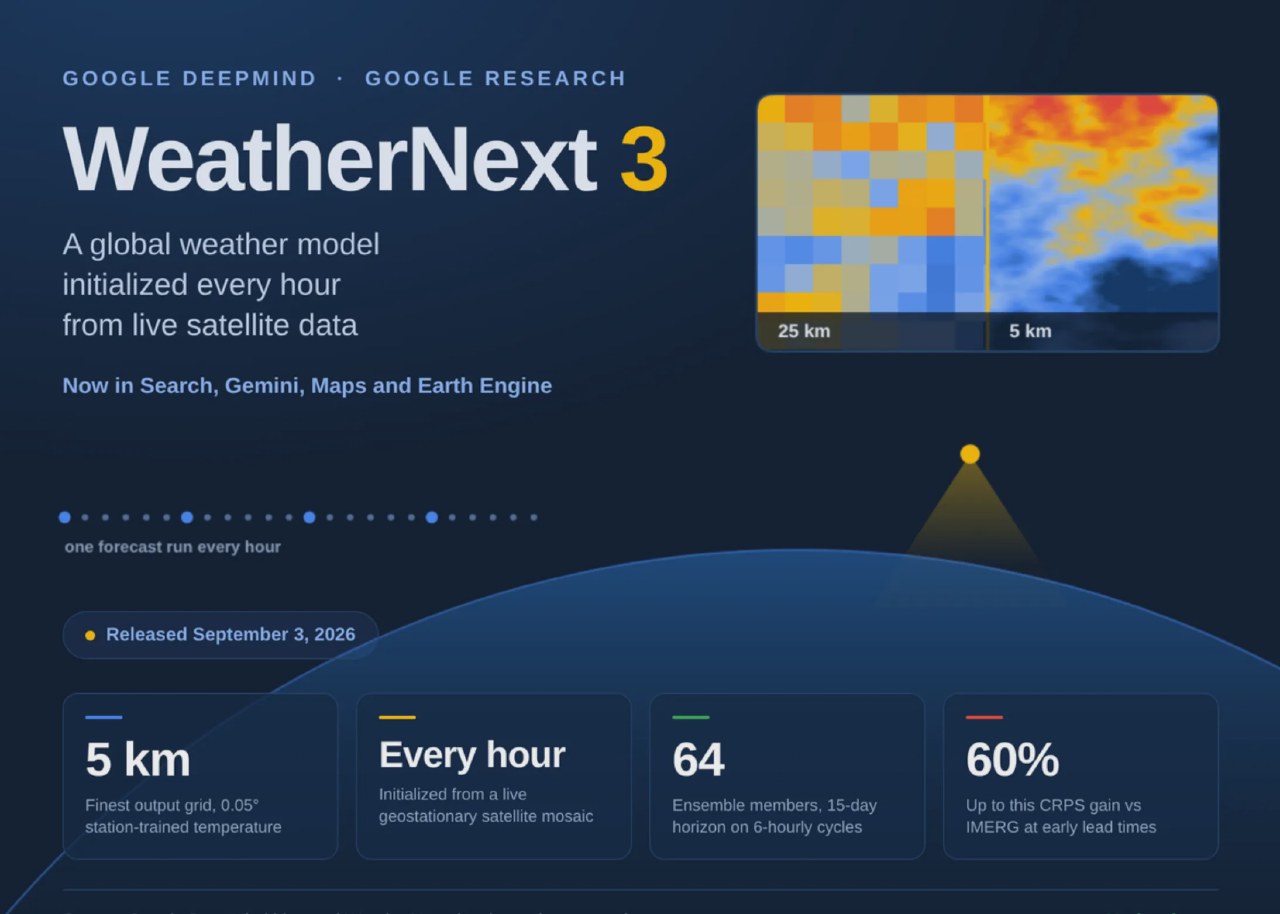
Google DeepMind has introduced WeatherNext 3, a Functional Generative Network mesh transformer designed for global weather forecasting. The model utilizes data from weather stations, satellite mosaics, and ECMWF HRES analysis to provide high-resolution outputs. It offers a 5 km resolution for temperature and dew point, 10 km for wind and solar radiation, and 25 km for atmospheric fields across 13 pressure levels.
The system updates 24 times daily, with synoptic cycles running up to 15 days using 64 ensemble members and interim runs covering 48 hours. This hourly refresh cycle is intended to improve accuracy for fast-developing weather events compared to traditional six-hourly models. The model specifically targets operational use cases, including renewable energy grid management by providing wind speed at turbine hub heights.
Performance metrics show significant improvements in precipitation forecasting. Google reports CRPS improvements of up to 60% against IMERG data, 30% against MRMS, and 10% against rain gauges. Additionally, the research indicates a 50% reduction in Brier score and CRPS compared to numerical weather prediction baselines. The model is currently accessible via BigQuery, Earth Engine, and Cloud Storage upon request.
While the model is available for enterprise use, its weights remain closed-source. Custom inference requests currently continue to utilize the previous WeatherNext 2 architecture. The shift to training on raw station observations allows the model to capture local variations in terrain that are often smoothed out in standard reanalysis methods.