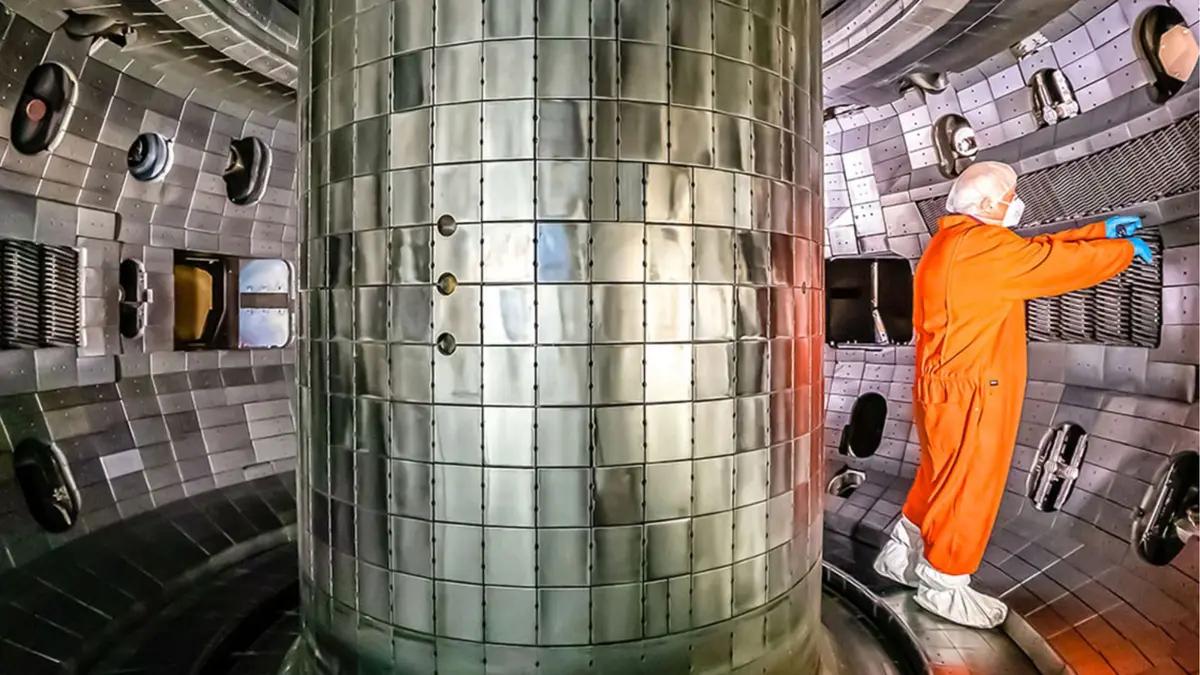
The DIII-D National Fusion Facility in California is partnering with Japan-based Kyoto Fusioneering to develop and test a new heat exhaust system. This project aims to address the critical engineering challenge of managing intense thermal loads to prevent damage to the reactor's internal walls. The experiments will be conducted on the DIII-D tokamak, which is funded by the U.S. Department of Energy.
The research focuses on a plasma configuration known as negative triangularity, where the plasma takes on an inverted D-shape. This geometry is expected to suppress sudden energy bursts that threaten reactor integrity. Kyoto Fusioneering will provide heat-resistant tiles for a specialized divertor, a component designed to extract heat and particles from the plasma chamber.
Following the installation of the new hardware, a team from DIII-D, Kyoto Fusioneering, and Columbia University will perform a series of tests. They plan to evaluate plasma behavior during sustained operations while measuring thermal loads and mechanical stress on internal components. The gathered data will be used to validate computer models for future fusion power plants.
The findings will be shared with the international DIII-D user community and integrated into the research initiatives of the U.S. Department of Energy. This work is intended to inform the selection of materials and the design of future experimental energy reactors, contributing to the broader development of fusion energy technology.