

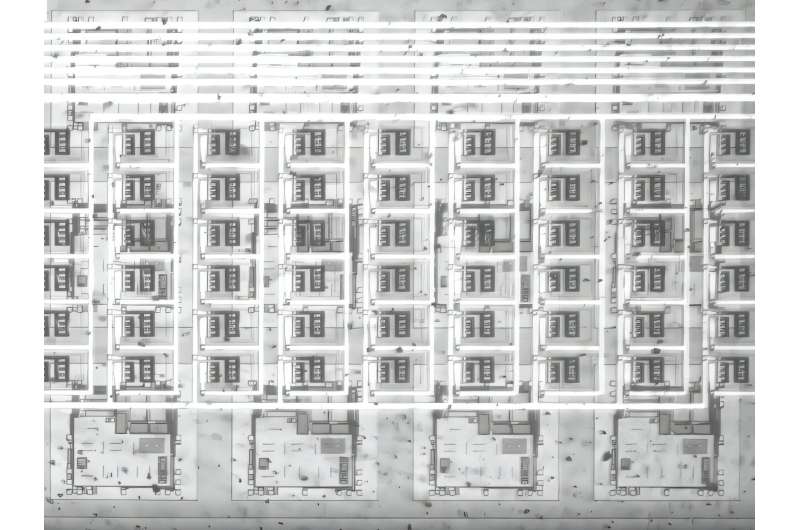
Researchers at Cornell University have developed a microscopic robot capable of sensing ambient temperature and altering its local environment. The study, titled Microscopic Robots that Sense and Reshape Their Environment, was published in the journal Nature Electronics.
The robots utilize an array of 54 artificial cilia, each featuring a dual-hinge design that moves in a paddle-like motion to pump liquid. This mechanism is controlled by two temperature-sensing circuits, designated as master and slave units, which communicate to synchronize the array.
The system functions as a feedback loop: if the temperature exceeds a set threshold, the cilia pump liquid in one direction; if the temperature is lower, they reverse the flow. This allows the robots to move fluids between hot and cold zones to regulate local temperature.
The team, led by physicist Itai Cohen, aims to expand these capabilities for potential applications in medicine and agriculture. Future iterations may respond to light or pH levels, with robots potentially operating independently rather than in fixed arrays.

