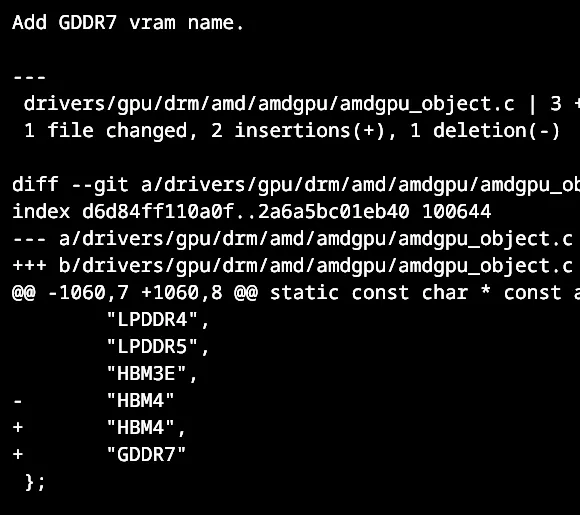
AMD is actively updating its open-source Linux kernel driver to include support for GDDR7 memory technology. Recent patches for the AMDGPU module introduce specific code for memory detection, frequency monitoring, and power management, which are essential for the next generation of graphics hardware.
The new driver updates incorporate specialized data structures and register definitions for GDDR7. Engineers have optimized support for high-speed point-to-point buses, PAM3 signaling, and dynamic voltage and frequency scaling (DVFS). These improvements aim to ensure high bandwidth and power efficiency for future hardware under Linux.
While the company has not explicitly named specific consumer models, these developments are linked to the upcoming RDNA 4 architecture and the Radeon RX 8000 series. The GDDR7 standard, promoted by JEDEC, offers double the transmission rates of GDDR6, addressing memory bandwidth bottlenecks in high-resolution rendering and complex computing tasks.
By integrating these patches into the mainline Linux kernel months ahead of the hardware launch, AMD intends to provide out-of-the-box support for Linux users and enterprise platforms. As these patches merge into upcoming kernel versions, further technical details regarding the performance and architecture of the next-generation GPUs are expected to emerge.