Anthropic Expands Open Source Security Scanning Efforts
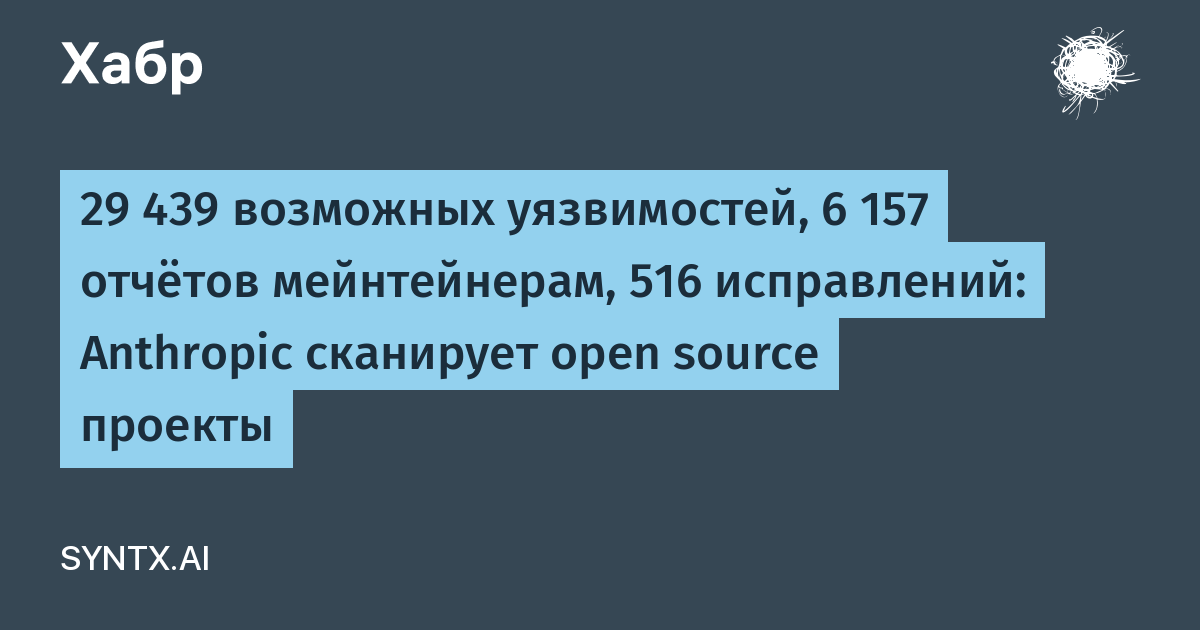
Anthropic has introduced an automated vulnerability scanner for open-source projects, reporting 516 fixes out of 6,157 reports generated from 29,439 potential security findings.

Anthropic has introduced an automated vulnerability scanner for open-source projects, reporting 516 fixes out of 6,157 reports generated from 29,439 potential security findings.

Google has increased the base reward for memory corruption vulnerabilities in Chrome to $2000, with top payouts for critical flaws reaching $20 000.

Microsoft has patched 1,411 vulnerabilities in its latest Windows update, marking a record-breaking volume for the company's monthly security cycle.
Censys reports a 63% surge in exposed AI infrastructure, with over 294,000 public IP addresses now linked to vulnerable AI and LLM tools.

The integration of AI into software development and security is accelerating the cycle of vulnerability discovery and exploitation, reducing the time between a patch release and a potential attack.

WordPress released version 7.1.3, patching seven security vulnerabilities and four bugs, with three of the flaws reported by AI firm Anthropic.
Anthropic is scaling its cybersecurity initiative, which has already helped identify over 130,000 software vulnerabilities using its most advanced AI models.

Anthropic has launched a three-tier Cyber Verification Program, integrating Project Glasswing to provide security teams with tiered access to its latest AI models.

R-Vision analysts identified four critical vulnerabilities in September 2026, three of which are already being exploited in real-world attacks against corporate systems.
Researchers have discovered a new Spectre-v2 attack method that exploits branch prediction via JIT compilers, successfully extracting data from modern processors in minutes.

Google has paused its open-source vulnerability reporting program until 2027 due to a flood of AI-generated spam reports.

Bi.Zone EASM reports that a significant portion of Russian companies expose critical database and remote access services to the public internet, increasing cybersecurity risks.
Google experts report that AI is accelerating the weaponization of known software vulnerabilities, forcing organizations to rethink their security patching strategies.
D-Link is investigating two critical vulnerabilities in its legacy DIR-822A routers after a researcher published proof-of-concept exploit code for both flaws.
Positive Technologies has flagged six critical vulnerabilities across major enterprise software platforms that are currently being exploited by attackers.
A developer has released a tool called BigDiskBuster that prevents Microsoft Defender from updating, marking the latest move in a long-standing conflict with the software giant.

Data from VulnCheck reveals that hackers have exploited less than 0.5% of vulnerabilities identified by Anthropic's AI-driven Glasswing project.

Intel has suspended its bug bounty program, which previously paid up to $100,000 per flaw, and shifted to a new disclosure platform that offers no financial rewards.

ENISA warns that frontier AI models have compressed the vulnerability exploitation window to minutes, forcing a shift toward automated, machine-speed cybersecurity defenses.

Microsoft has set a new record by releasing 974 security patches in a single month, driven by the increased use of AI in vulnerability detection.