

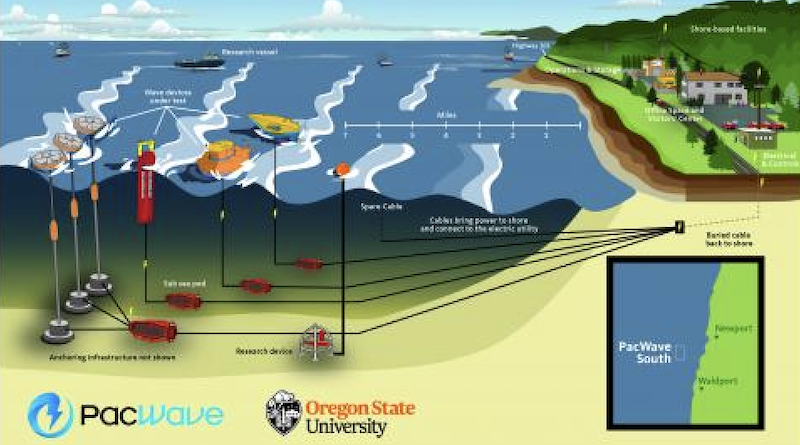
The US Department of Energy has officially opened the PacWave South facility, a grid-connected, open-water wave energy test bed located seven miles off the Oregon coast. The site is designed to accelerate commercial development by providing pre-permitted berths, which eliminates the need for developers to navigate lengthy regulatory approval processes for testing their devices.
PacWave South features four berths capable of accommodating up to 20 wave energy converters. The facility offers shared mooring systems intended to reduce costs for stakeholders. The Bonneville Power Administration has already signed an agreement to purchase electricity generated by devices tested at the site, and operators have begun preparations for initial testing.
Marine energy leverages the kinetic energy of waves, tides, and currents. While the industry faces significant engineering challenges, the US government continues to support research through the TEAMER organization and collaborations with Norway. The Department of Energy estimates that US coastal regions hold a potential capacity of 1,170 terawatt-hours of zero-emission electricity annually.
In Hawaii, the National Laboratory of the Rockers and the University of Hawaii are currently testing the SURF-WEC converter. This small-scale device, roughly the size of a large television, uses a hydraulic system to generate power. Researchers are using the MODAQ 2.0 platform to collect and share real-time performance data to help the industry improve system efficiency.