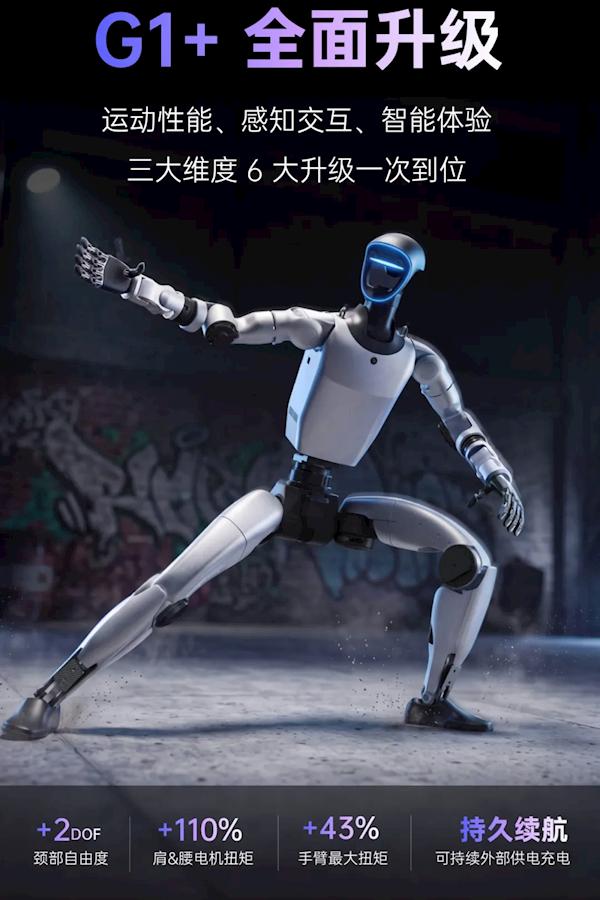
Unitree has officially unveiled the G1+ humanoid robot, featuring six key upgrades over its predecessor. The development team focused on enhancing the motor system, environmental perception, and human-robot interaction. The robot now includes a neck with two degrees of freedom, allowing for a tilt range of -25 to 36 degrees and a rotation of up to 110 degrees.
The electric motors have undergone significant redesigns. Shoulder and waist actuators now offer a 110% increase in peak torque with a 72% reduction in heat generation. Arm motors show a 43% torque increase and 30% less heat, while hip actuators report a 28% reduction in heat. The sensory suite includes a binocular camera, a wide-angle camera, a 3D LiDAR, and an additional abdominal camera.
Interaction capabilities are supported by five head-mounted sensors, a six-microphone array with noise and echo cancellation, and two 10-watt speakers. The 9000 mAh battery provides approximately 2 hours of operation and is swappable. Connectivity options include Wi-Fi 6 and Bluetooth 5.2, with support for OTA updates and manual remote control.
The standard G1+ model features 25 degrees of freedom, weighs approximately 35 kg, and has a 3 kg payload capacity per arm. The G1+ EDU version expands this to 70 degrees of freedom, including hands with 7 degrees of freedom. The standard version is priced at ¥95 000 or $14 000, while the price for the EDU variant remains undisclosed.
Unitree robots have demonstrated significant capabilities in recent months. In June 2026, a modified G1 named Pemba climbed the Chimborazo volcano, reaching an altitude of 6 200 meters over 16 hours. In August 2026, a unit achieved a standing jump of 2 meters and reached a speed of 12,66 meters per second.