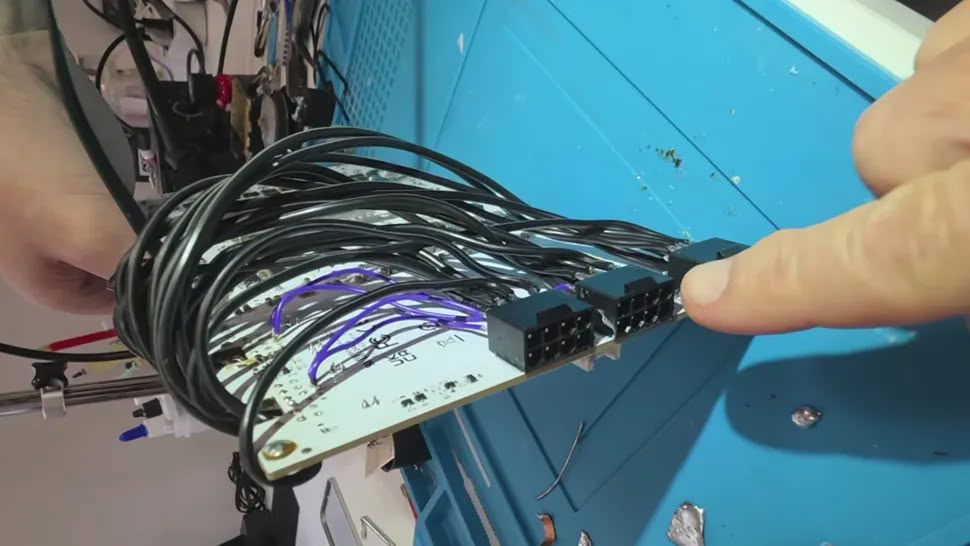
Enthusiasts have successfully modified an NVIDIA GeForce RTX 5090 graphics card to replace the standard 16-pin 12V-2x6 power connector with multiple traditional 8-pin PCIe power ports. The modification addresses concerns regarding the reliability and potential overheating issues associated with the high-density 16-pin interface used in modern flagship GPUs.
The RTX 5090 features a design power consumption of 575W. A simple adapter is insufficient for this load, as a single 8-pin connector is typically rated for approximately 150W. The modders redesigned the card's power delivery circuit to distribute the 575W load across several independent 8-pin connectors, preventing any single point of failure or thermal overload.
While the modification proves that the RTX 5090 can operate without the 16-pin interface, it requires significant hardware intervention, including changes to the PCB power network. The approach increases cable clutter and reduces internal chassis space, highlighting the trade-off between the compact 16-pin design and the bulkier, more traditional multi-cable power delivery method.
The project serves as a technical demonstration rather than a practical alternative for average users. Experts emphasize that the core requirement for high-power GPUs remains the safe and uniform distribution of current. For standard users, utilizing high-quality 12V-2x6 cables and ensuring proper insertion remains the recommended approach for stable operation.