

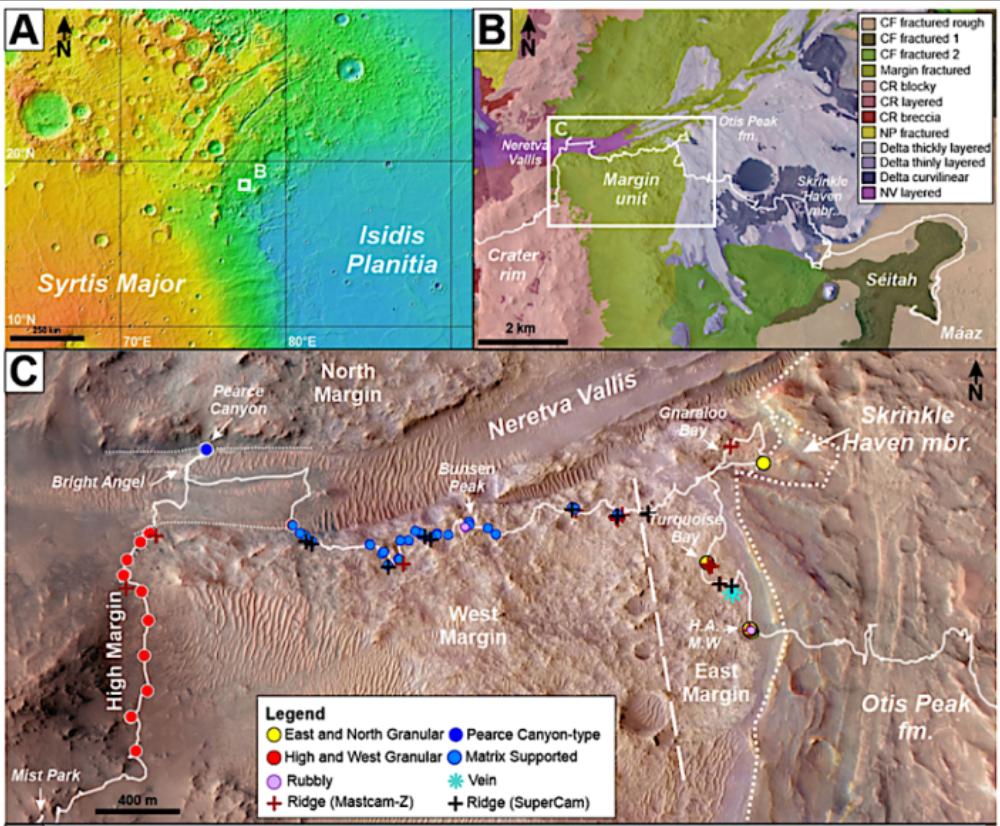
The Perseverance rover identified evidence of three distinct water-related events within the Margin Unit area of the Jezero crater. While researchers expected to find sedimentary rocks, the rover discovered igneous rocks that reveal a complex history of geological interactions.
Initial interactions involved carbon dioxide-rich groundwater reacting with olivine, which deposited carbonates within rock fractures. Subsequently, water from the ancient lake caused further alteration, resulting in cracked olivine grains and the formation of silica deposits.
The third event involved a later hydrothermal system. The rover identified mineral veins up to 25 centimeters thick containing calcium sulfate and fluorite, suggesting the circulation of heated water through volcanic rock.
Perseverance analyzed over 185 bedrock sites across a 265-meter elevation range using its SuperCam instrument. While scientists can now reconstruct the sequence of these water-related events, they have not yet determined their precise age.



