

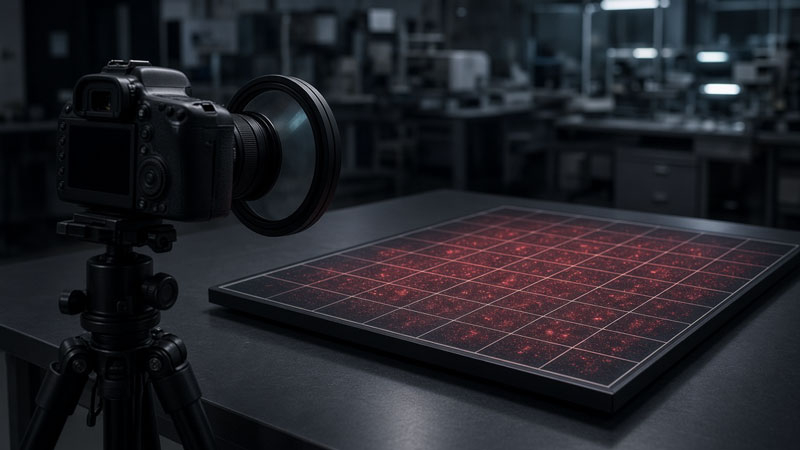
German researchers have developed a method to use a modified consumer-grade Canon EOS 4000D digital camera for the quantitative diagnostics of silicon solar cells. The technique relies on electroluminescence, where solar panels emit weak infrared radiation when connected to a power source.
To capture this radiation, the team removed the camera's standard infrared-blocking filter and installed a Heliopan ES RG850 long-pass filter. The CMOS sensor, which is silicon-based, can detect radiation near 1120 nm, allowing the camera to record the electroluminescence emitted by the panels.
The researchers created a calibration model that accounts for both linear and non-linear sensor operation to convert pixel brightness into absolute external electroluminescence quantum efficiency (EQE_LED). A reference element with known values is used to anchor the measurements.
Experimental results showed that at room temperature, a tenfold increase in the luminescence signal corresponds to approximately 60 mV of increase in open-circuit voltage. While the method is highly accurate for new modules, results for older panels currently show discrepancies that require further study.
This approach moves beyond simple visual defect detection, enabling precise quantitative analysis of solar panel performance. The team is now exploring the potential to apply this model to photoluminescence measurements under ambient light conditions.

