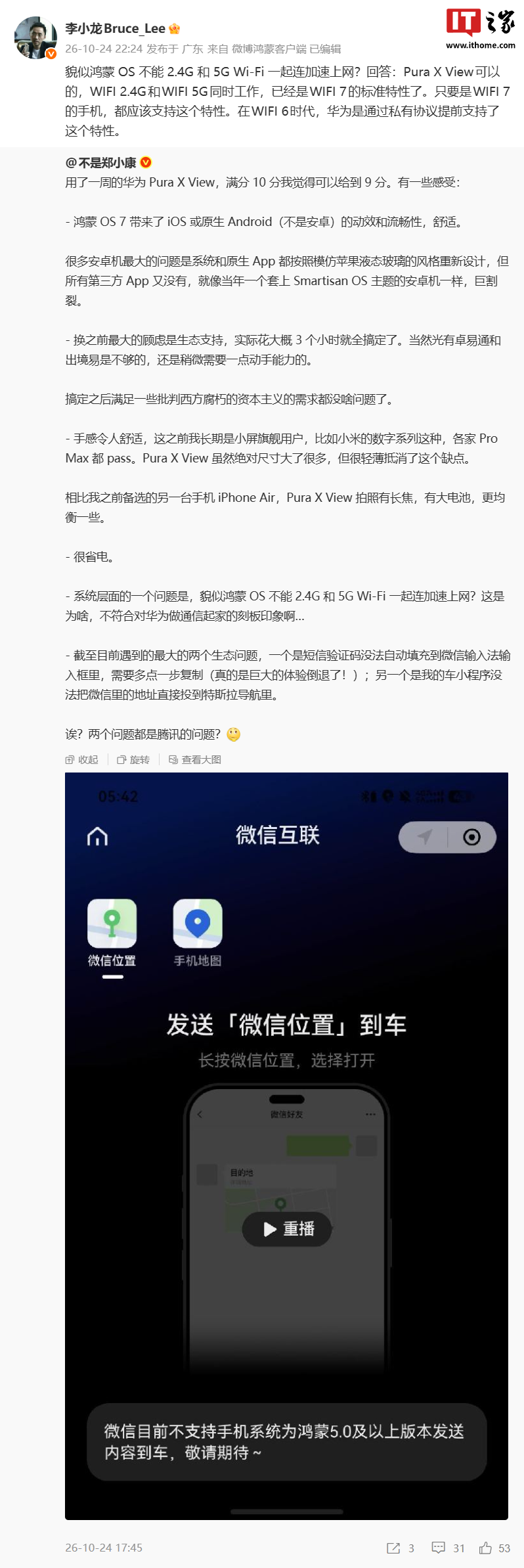
The simultaneous operation of 2.4 GHz and 5 GHz Wi-Fi bands is a standard feature of the Wi-Fi 7 protocol. All smartphones equipped with Wi-Fi 7 technology are expected to support this dual-band concurrency.
During the Wi-Fi 6 era, Huawei implemented this capability through a proprietary protocol. The company introduced Wi-Fi 6+, a self-developed chip-level coordination technology designed to improve anti-interference performance.
Utilizing Wi-Fi 6+ requires both the mobile device and the router to support the standard, with some models specifically requiring the Lingxi Dual Wi-Fi feature. This technology builds upon the base Wi-Fi 6 protocol.
In the Wi-Fi 7 era, Huawei launched the Wi-Fi 7+ end-to-end chip solution. This architecture relies on the Lingxiao 760 series chips, with the 760 model used in routers and the 760M variant integrated into smartphones and tablets.
The Wi-Fi 7+ solution supports advanced technical features including dynamic narrow bandwidth, true dual-band concurrency, and seamless roaming. These capabilities are enabled by the end-to-end common architecture of the Lingxiao chips.