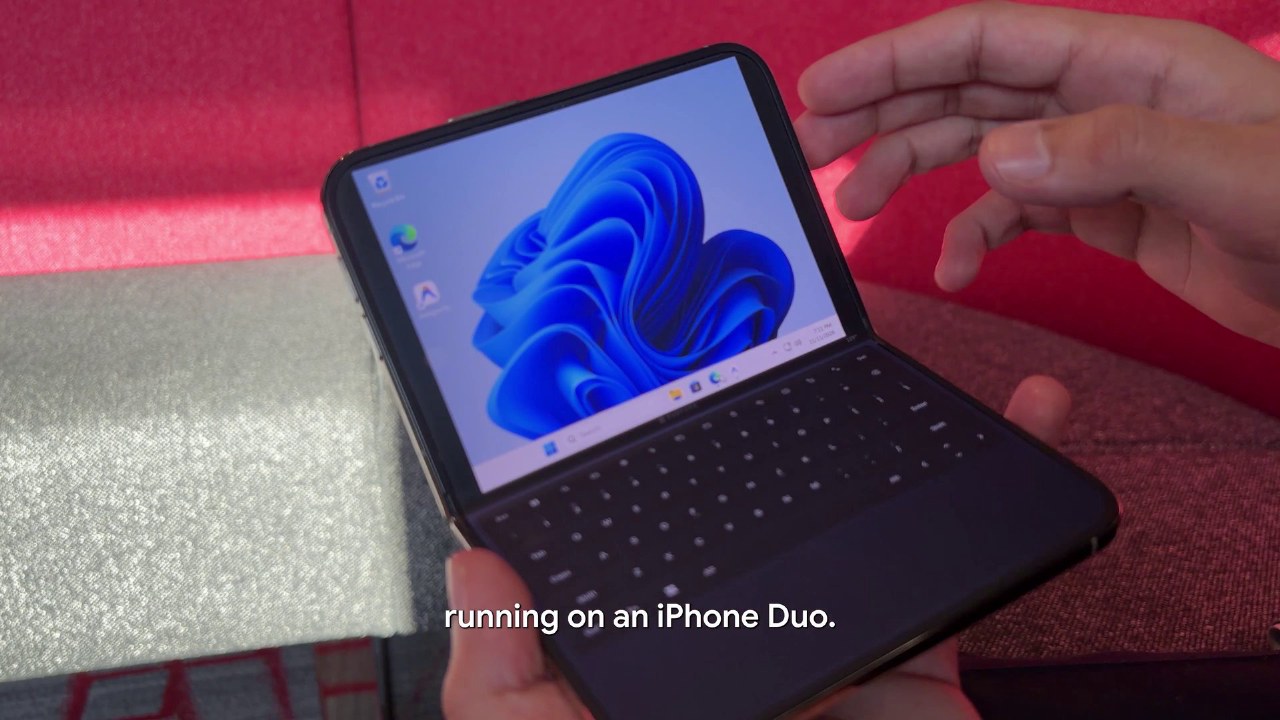
Ammaar Reshi, a product and design lead at Google AI Studio, has launched an open-source project called WindowsiOS. The initiative successfully runs the ARM version of Windows 11 24H2 on Apple's foldable iPhone Duo device.
The system operates locally via virtualization rather than cloud streaming. The project utilizes the Gemini 4 Carbon AI model to assist with system deployment and adaptation, with the developer reporting that the AI agent completed the primary workflow in approximately two hours.
The software adapts to the device's folding state. When fully unfolded, it displays the desktop; when partially folded, it switches to a laptop-like layout featuring a virtual keyboard and trackpad. The virtual keyboard includes F1-F10 keys, a Copilot button, and directional keys.
The project does not require jailbreaking the iPhone. It uses JIT translation to execute ARM64 code and bypass hardware virtualization restrictions. The environment occupies about 12GB of storage and includes an optimized Windows image with Defender and Windows Update services disabled to improve performance.
The system supports the Prism translation layer, theoretically allowing some x86 and x64 applications to run on the device. It also features virtualized hardware components, including Ethernet adapters and audio drivers, allowing the OS to function as if it were on a standard PC.