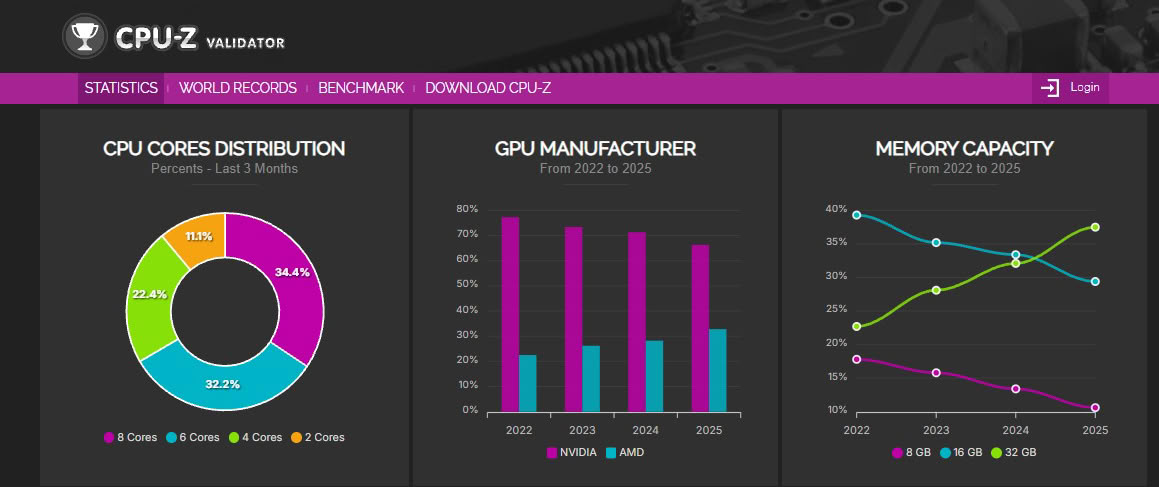
Recent statistics from the CPU-Z Validator indicate a shift in PC memory configurations, marking the first year-over-year decline in average RAM capacity. While 32 GB remains the leading setup at 37.2% of validations, its share dropped by 2.5% compared to the previous year. Meanwhile, the 64 GB configuration saw a significant decrease of 18%, falling to 7.3%.
Conversely, smaller memory capacities are gaining popularity. The 16 GB configuration grew by 12.9% to reach a 33.0% share, and 8 GB setups increased by 5.5% to 11.0%. High-capacity systems, specifically 96 GB and 128 GB, experienced a decline of more than 26% each. These figures reflect data submitted by users over the last three months.
Memory type trends show DDR4 accounting for 54.5% of validations, an increase of 6.0%, while DDR5 usage fell by 2.9% to 32.9%. Market analysts attribute these shifts to rising memory prices. Team Group anticipates a peak in supply shortages between Q4 2026 and Q2 2027, with new DDR4 motherboards for LGA1700 processors expected in early 2027.