

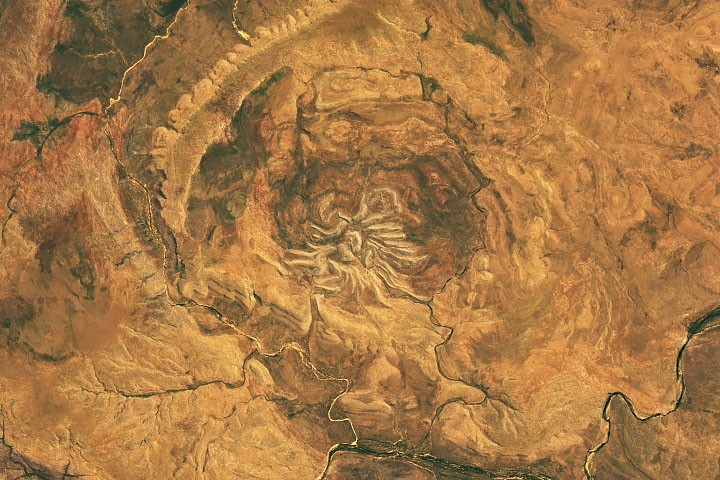
The Spider Crater, located in the Kimberley region of Western Australia, is a geological formation resulting from a prehistoric meteorite impact. NASA's Landsat 9 satellite, equipped with the OLI instrument, captured imagery of the site on September 20, 2026.
The crater spans an oval area measuring 13 kilometers by 11 kilometers, with a central structure approximately 4 kilometers wide. Geologists attribute the distinct arachnoid pattern to a central uplift formed during the impact, where sandstone ridges remained after surrounding rock layers eroded.
Researchers confirmed the impact origin by identifying shatter cones, which are fan-shaped fractures created by intense shock waves. Further laboratory analysis of shocked quartz and zircon crystals from the site supports this conclusion.
While the exact timing of the event remains uncertain, geological estimates suggest the impact occurred between 900 million and 600 million years ago. This places the formation of the Spider Crater in the late Precambrian period.



